Showing posts with label Low Key. Show all posts

Wednesday, 2 December 2020

Blidworth Woods - Part 1 (November 2020)

As I stated in my last post, I was keen to get out with the camera as much as possible in the first weeks of November to capture the peak of the autumn colours. The only thing holding me back was the weather. 

I was looking mainly for bright sunny days but on occasions, like this visit to Blidworth Woods, the forecasted light never materialised except for the odd momentary burst of sunlight through the clouds. The following day, however, proved to be very different with uninterrupted sun for the whole of the morning until it clouded over shortly after midday. 

Although not considered at the time and something that only occurred whilst processing the images, the change in conditions provided an opportunity to compare the photography from two days at the same venue - one visit with direct sunlight (or incident light) and the other with low light. 

Without direct light the woodlands can be very flat and dark, possibly uninspiring for photography. Modern cameras, however, seem very able to cope with this and pushing the ISO levels to gain a balanced exposure doesn't have the spoiling impact it had in the past. 

There is also a certain freedom in flat conditions to choose the composition as incident light is not dictating the subject. In these circumstances, I often find myself zooming into the colour to create the interest. 

These were some of the results from the low light visit to Blidworth Woods and I particularly enjoy some the muted tones from the birch trees:


Saturday, 8 April 2017

Clumber Park - Photography Week 12 (2017)

This set of photographs centres mainly on the wetland area in Clumber Park where the River Poulter feeds into Clumber Lake. This sounds quite dramatic but it is actually very gentle.

Much of the area is naturally overgrown and a haven for wildlife but the subjects that caught my eye were the details on the waters edge and in particular some of the reflections. Most of this I captured in black and white as this example image shows:


Before moving on to the reflections it is worth setting more of the context for these pictures using these photographs of the water's edge:


What can be seen in the above images is the way the branches reflect in the lake. Some are in bright open water and others closer to the bank have more darker areas. This led to two distinct panels of black and white photographs.

The first panel is characterised by gaining clarity between the reflected branches and the water which could be described as a high key finish:


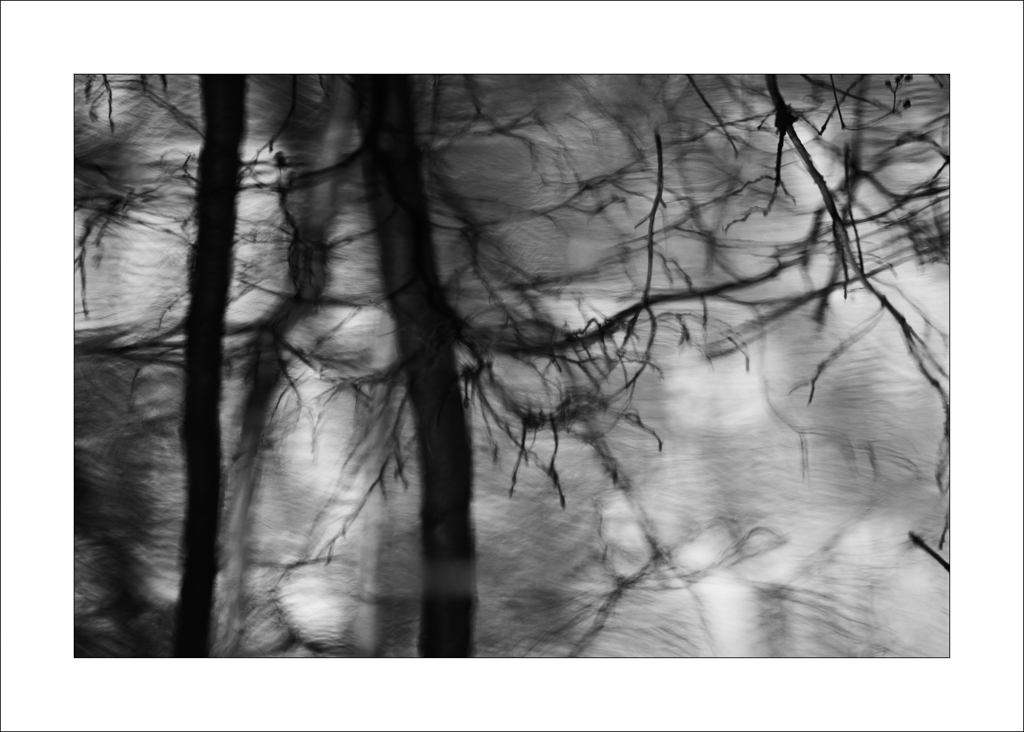
The second panel takes the alternative low key approach creating a softer and more ambiguous representation of the reflections:


I find the low key panel more intriguing. The dark shadows and movement created by longer exposure times creates a mood that holds the attention longer than sharper or more defined higher key studies. That said, I find the first image in the higher key panel particularly engaging.

Finally, continuing the black and white theme is a small panel focusing on details at the waters edge. What I am trying to achieve here is a sense of elegance in the compositions.

Elegance often comes from simplicity of lines and in particular curves. The first image in this post is an example of lines creating a simple and possibly elegant composition - although this sense of elegance has been enhanced by the digital removal of some bubbles and other debris in the water. The original unaltered version is posted below along with some alternative compositions:


Whether digitally 'cleaning' images is considered acceptable depends upon your point of view and how the picture is being presented - there has been a lot controversy about the airbrushing of celebrities in magazines for instance.

As a predominately landscape photographer, I tend to remove only aspects of a scene that are considered temporary e.g. a distracting white van parked in the distance, a aeroplane's vapour trail in the sky or a piece of rubbish in the foreground. At the end of the day I doubt that anyone is going to get too worked up about the removal of debris around a blade of grass in water but it does question the difference between a representation of the natural world versus photo-art and hence the need to be clear about what is being presented.