Sitting high the cliffs close to Chapel Porth is Wheal Coates, a former tin mine which includes the Towanroath engine house. The location is absolutely perfect for landscape photography and, despite photographing it many times, there is always a detail either in landscape, or the weather, that makes me reach for the camera.
On this occasion it was a patch of pink thrift positioned nicely on the coastal path which caught my eye. Interestingly though, whilst the composition was obvious, it took a while to line up the shot. Maximising the foreground and getting the positioning of the engine house correct was the challenge. Even slight corrections changed the composition as demonstrated in the following two images:
In the first image the engine house and the clouds sit nicely in the composition. However, the foreground in the second image is far superior but the engine house is little too far to the right and the framing on the clouds is less effective. These are only small margins but they make a difference and demonstrates that whilst the location may be perfect for photography, there is no such thing as a perfect photograph.
When the tide allows, there is an alternative view of the engine house from the beach at Chapel Porth. The standing sea water can be used to add a reflection into the composition:
Of course, the engine house doesn't need to be every shot at this venue. In fact many photographers would deliberately exclude the building and references to location, preferring compositions that are based on shape, form, colour and texture. Photographs with obvious references to locations can be seen as clichéd or postcard photography.
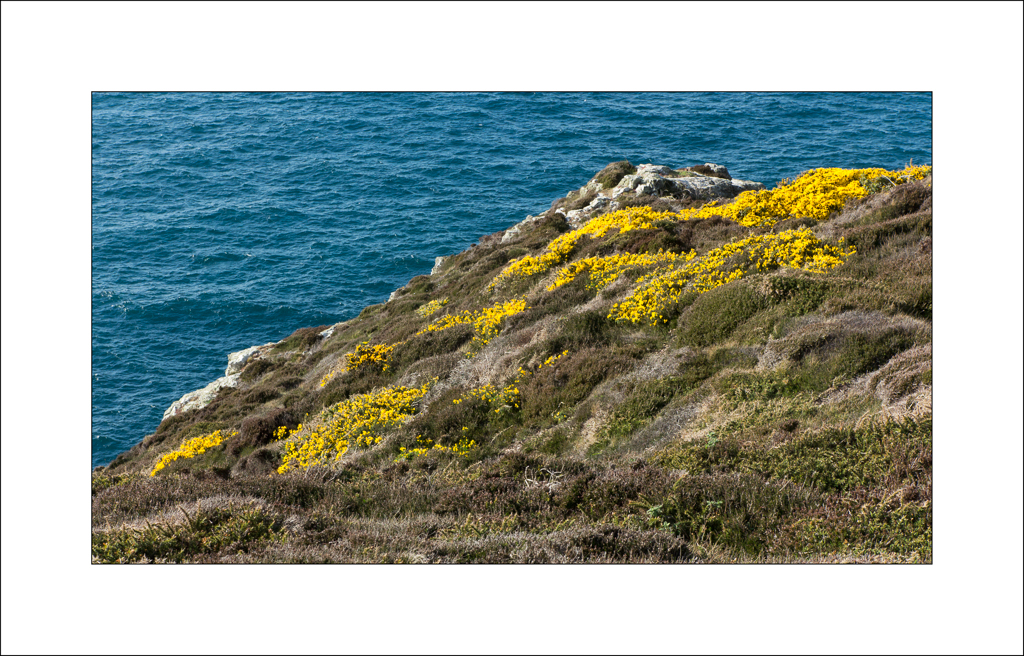
For example, I have removed much of the locational information in the next set of images. The beach compositions are now about the sand patterns and the light. The cliff top image concentrates on colour and relationship between the yellow gorse flowers and the blue sea:
From my point of view, I see photographs which include elements like the Towanroath engine house as landscape standards. The aim is to represent the scene in the best possible way. I also see that landscape photography needs to be progressive and this means challenging the viewer beyond simple references to location.
Showing posts with label Thrift. Show all posts
Tuesday, 30 May 2017
Friday, 22 July 2016
Kynance Cove: Day 2 - Photography Week 23 (2016)
The previous evening I had seen a number of interesting wildflowers in Kynance Cove. The light wasn't right to capture these so I decided to make a further visit in brighter conditions. I also wanted to take a closer look at the serpentine rocks on the beach at low tide.
When researching Kyannce Cove for my blog post 7th June 2016, I was aware that it was home to several rare or uncommon species of wildflowers. One mentioned was the Bloody Cranesbill (Geranium sanguineum): a reddish purple flower with distinctive red veins and a red style:
Also mentioned was the Burnet Rose (Rosa pimpinellifolia):
Whilst scouting around I captured this more common Tormentil (Potentilla erecta) and a Common Catsear (Hypochaeris radicata):
Thrift (Armeria maritime) is very common on the Cornish cliffs this time of year but this is the first time I had really looked closely at the individual flower heads - beautiful:
Also close to where I took the long exposure the previous day was this Early Purple Orchid (not totally sure on the ID of this one):
Apart from the wildflowers I had an opportunity to walk on the beach at low tide and in particular the tombolo which connects the Asparagus Island to the mainland. Sitting in the middle is the imposing Steeple Rock:
The rocks on the beach are Serpentinite, a rare exposure of the Earth's mantle pushed to the surface 300 million years ago as two continental plates collided. Up close they have a distinctive mottled green and red appearance:
In my previous posts I had challenged the notion of Kynnance Cove being a pretty cove and preferred my description of beauty inspired by the power of nature. Having now spent time on the beach at low tide I can certainly see why visitors flock to this part of the coast on a summer's day - it is pretty. That said, the landscape photographer in me will tend to favour the wilder and more dramatic conditions!
When researching Kyannce Cove for my blog post 7th June 2016, I was aware that it was home to several rare or uncommon species of wildflowers. One mentioned was the Bloody Cranesbill (Geranium sanguineum): a reddish purple flower with distinctive red veins and a red style:
Also mentioned was the Burnet Rose (Rosa pimpinellifolia):
Whilst scouting around I captured this more common Tormentil (Potentilla erecta) and a Common Catsear (Hypochaeris radicata):
Thrift (Armeria maritime) is very common on the Cornish cliffs this time of year but this is the first time I had really looked closely at the individual flower heads - beautiful:
Also close to where I took the long exposure the previous day was this Early Purple Orchid (not totally sure on the ID of this one):
Apart from the wildflowers I had an opportunity to walk on the beach at low tide and in particular the tombolo which connects the Asparagus Island to the mainland. Sitting in the middle is the imposing Steeple Rock:
The rocks on the beach are Serpentinite, a rare exposure of the Earth's mantle pushed to the surface 300 million years ago as two continental plates collided. Up close they have a distinctive mottled green and red appearance:
In my previous posts I had challenged the notion of Kynnance Cove being a pretty cove and preferred my description of beauty inspired by the power of nature. Having now spent time on the beach at low tide I can certainly see why visitors flock to this part of the coast on a summer's day - it is pretty. That said, the landscape photographer in me will tend to favour the wilder and more dramatic conditions!
Labels:
Asparagus Island,
Bloody Cranesbill,
Burnet Rose,
Common Catsear,
Cornwall,
Early Purple Orchid,
Kynance Cove,
Serpentine,
Steeple Rock,
Thrift,
Tombolo,
Tormentil
Location:
Landewednack TR12, UK
Thursday, 14 July 2016
Bedruthan Steps - Photography Weeks 19 and 20 (2016)
Fine weather was forecast for the first trip to Bedruthan Steps. In reality it turned out to be a bit murky. Trying to make the most of it, I looked for alternative sources of colour and interest on the beach:
The second trip, a couple of days later, started with better weather:
I had a couple of aims for the trip: capturing the stacks on the beach at low tide and thrift on the cliff top in evening light. Both required a bit of a wait so I filled the time scouting along the coastal path:
As soon as the tide allowed I went down to the beach and captured these wet sand scenes:
Within a short while the blue skies where replaced by cloudier conditions allowing these shots into the light. This particular stack is known as the Queen Bess Rock due to its apparent likeness to Elizabeth I (I wasn't sure I could see this but was more convinced when I found this link). I later converted the images to black and white:
At this point I could see the possibility of losing the light for the evening and it was decision time. I could either stay longer on the beach or head for the cliff top as planned. I decided on the latter which meant a quick climb up the 100 plus steps from to the beach.
I recovered enough to take these shots before the light faded:
There were a couple of glimpses of sunlight after this but nothing to brighten the foreground:
There was some great colour from the thrift on the cliff top:
The second trip, a couple of days later, started with better weather:
I had a couple of aims for the trip: capturing the stacks on the beach at low tide and thrift on the cliff top in evening light. Both required a bit of a wait so I filled the time scouting along the coastal path:
As soon as the tide allowed I went down to the beach and captured these wet sand scenes:
Within a short while the blue skies where replaced by cloudier conditions allowing these shots into the light. This particular stack is known as the Queen Bess Rock due to its apparent likeness to Elizabeth I (I wasn't sure I could see this but was more convinced when I found this link). I later converted the images to black and white:
At this point I could see the possibility of losing the light for the evening and it was decision time. I could either stay longer on the beach or head for the cliff top as planned. I decided on the latter which meant a quick climb up the 100 plus steps from to the beach.
I recovered enough to take these shots before the light faded:
There were a couple of glimpses of sunlight after this but nothing to brighten the foreground:
Labels:
Beach,
Bedruthan Steps,
Cornwall,
Intimate Landscape,
Queen Bess Rock,
Rock Studies,
Thrift
Friday, 17 June 2016
The Lizard - Photography Week 19 (2016)
We spent a very pleasant sunny afternoon at the Lizard, walking along the cliff path and enjoying the wonderful spring wildflowers. The thrift was particularly vibrant:
Colour on the cliff face:
Bluebells, three cornered leeks, thrift, pink and sea campion on the cliff top:
Polpeor Cove and the disused lifeboat station - obviously taking account of the many warning signs!
Colour on the cliff face:
Polpeor Cove and the disused lifeboat station - obviously taking account of the many warning signs!
Labels:
Bluebells,
Colour,
Cornwall,
Disused,
Lifeboat Station,
Lizard,
Pink Campion,
Polpeor Cove,
Sea Campion,
Three Cornered Leeks,
Thrift,
Warning Signs
Location:
The Lizard, Helston, Cornwall TR12, UK
Subscribe to:
Posts (Atom)