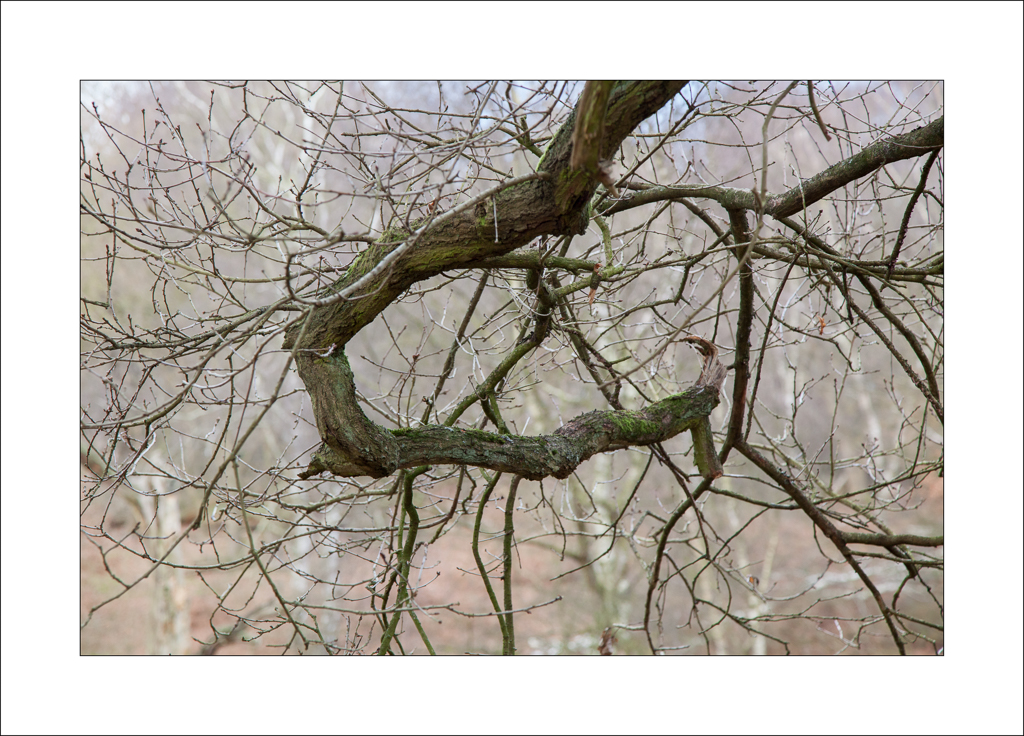
Abstract photography concentrates on shape, form, colour, pattern and texture. In doing so it removes the wider context to focus on small sections or details of a subject, often obscuring its identity.
Taking abstracts is probably different to other types of photographic genres. They tend to be more spontaneous and opportunistic, and whilst I can pre-visualise landscape compositions in some detail, planning abstracts is restricted to generalised themes e.g. reflections, rock surfaces, rust, tree bark etc.
In addition, I find that abstracts require flexibility at the point of capture and I often prefer to use a point and shoot compact camera rather than the more rigid DSLR set-up. I think this has something to do with a concentration on the key elements of abstract photography (shape, form, colour, patterns and texture) and not being distracted by the technical aspects of image capture.
During photography week 8, there were a couple of opportunities for abstract photography. The first was reflections in the sailing lakes near Hovingham, East Midlands. There was sufficient air movement to ripple the water and by including only the patterns and colours in the lake they became more abstract:
Walking across one of the local fields, I noticed that the path was already dry and cracking despite the time of year. This led to a series of abstract shots using the embedded stones to anchor some of the compositions. It is an unusual subject and one I tried before... but normally in summertime:
In these tree bark shots I altered the contrast to impact on the perception of the textures:
Point of view plays a role in creating abstract compositions as demonstrated in these final images. The first looks down on a tree stump and the second looks along a tree branch with twigs fanning out in all directions:
Showing posts with label Hoveringham. Show all posts
Sunday, 19 March 2017
Friday, 17 March 2017
Hoveringham - Photography Week 8 (2017)
The River Trent is currently a gap in my attempts to document aspects of the landscape in the Newark and Sherwood District of Nottinghamshire.
Last year, I spent time visiting some of the locks and weirs and there was one successful landscape taken near Gunthorpe. This year I want to continue to build the portfolio and a walk from Hoverinham towards Hazelford was a good opportunity to explore an area that I have only briefly visited in the past.
The focus for my initial shots was the high tree-lined bank on the Kneeton side of the river. The first image successfully shows the nature of this part of the Trent - aided by some pleasant sunlight. This is followed by a series of different compositions which includes trees on both banks. In some of the shots the river is excluded or only partial visible presenting a more subtle representation of the Trent. I think the falling and fallen trees say something about the power of the river but some of the others studies may only be relevant to the topic if viewed as part of a large panel:
Historical events play a part in telling the story of a place and the memorial to the lost crew of two crashed Lancester bombers is one such example. Sadly, 14 men were killed whilst carrying out separate training exercises in the area in 1945 (1):
Like many of my photographic projects documenting the Newark and Sherwood landscape including the River Trent, will remain open ended. I have a target in mind but completion is reliant on identifying the right compositions and being able to capture them a different times of the day with the 'right' lighting conditions. My recent Robin Hood Hill posts are good example of this process in action.
(1) http://www.nottinghampost.com/bygones-wartime-crash-site-unearthed-hoveringham/story-12219979-detail/story.html
Last year, I spent time visiting some of the locks and weirs and there was one successful landscape taken near Gunthorpe. This year I want to continue to build the portfolio and a walk from Hoverinham towards Hazelford was a good opportunity to explore an area that I have only briefly visited in the past.
The focus for my initial shots was the high tree-lined bank on the Kneeton side of the river. The first image successfully shows the nature of this part of the Trent - aided by some pleasant sunlight. This is followed by a series of different compositions which includes trees on both banks. In some of the shots the river is excluded or only partial visible presenting a more subtle representation of the Trent. I think the falling and fallen trees say something about the power of the river but some of the others studies may only be relevant to the topic if viewed as part of a large panel:
Historical events play a part in telling the story of a place and the memorial to the lost crew of two crashed Lancester bombers is one such example. Sadly, 14 men were killed whilst carrying out separate training exercises in the area in 1945 (1):
Like many of my photographic projects documenting the Newark and Sherwood landscape including the River Trent, will remain open ended. I have a target in mind but completion is reliant on identifying the right compositions and being able to capture them a different times of the day with the 'right' lighting conditions. My recent Robin Hood Hill posts are good example of this process in action.
(1) http://www.nottinghampost.com/bygones-wartime-crash-site-unearthed-hoveringham/story-12219979-detail/story.html
Subscribe to:
Posts (Atom)